 Details:
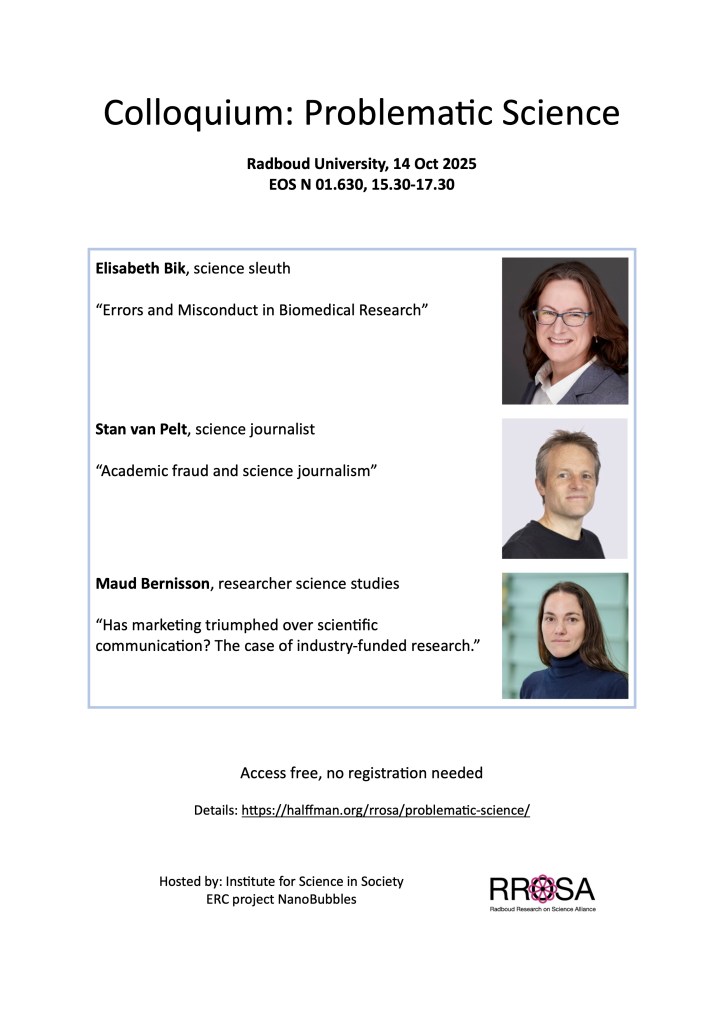
Elisabeth Bik: “Errors and Misconduct in Biomedical Research”
Abstract: Science builds upon science. Even after peer-review and publication, science papers could still contain images or other data of concern. If not addressed, papers containing incorrect or even falsified data could lead to wasted time and money spent by other researchers trying to reproduce those results. Several high-profile cases of science misconduct have been reported, but many more remain undetected. Elisabeth Bik is an image forensics detective who left her paid job in industry to search for and report biomedical articles that contain errors or data of concern. She has conducted a systematic review of 20,000 papers across 40 journals and found that approximately 4% of these contained inappropriately duplicated images. In her talk, she will present her work and show several types of inappropriately duplicated images and other examples of research misconduct. In addition, she will discuss how Artificial Intelligence can both help identify cases of misconduct and also create them, as well as the growing threat of scientific paper mills.
Bio: Elisabeth Bik, PhD, is a Dutch-American microbiologist who has worked for 15 years at Stanford University and 2 years in industry. Since 2019, she is a science integrity consultant who scans the biomedical literature for images or other data of concern. She has found over 8,000 problematic scientific papers. Her work has resulted in over 1,500 retractions and another 1,100 corrections. For her work on exposing threats to research integrity, she received the 2021 John Maddox Prize and the 2024 Einstein Foundation Award.
Stan van Pelt, “Academic fraud and science journalism”
Abstract: Most media only report on science to communicate new scientific insights and achievements. Here, they generally assume that scientists and scientific publications are reliable, especially when the latter have undergone peer review. This approach leads to a situation where problematic papers often are only recognised as such in second instance, e.g. when someone files an integrity complaint. This even holds for most science journalists, although there are exceptions. Also, such problems are often considered an internal academic issue that is not interesting enough for the general public. This dynamic resembles the discomfort sports journalists feel when reporting on doping use. As a result, generating attention for integrity issues can be very challenging and frustrating for whistleblowers and sleuths. I will discuss some examples to illustrate this and discuss how journalists and whistleblowers can navigate this complex topic.
Bio: Stan van Pelt is a freelance science journalist and part-time lecturer in (popular) science writing at Radboud University. He has a PhD in neuroscience and 15 years of academic experience in research. His journalistic work is published in newspapers (de Volkskrant, De Gelderlander), magazines, and independent university media. At Nijmegen-based Vox, he was the science editor for three years. In 2020, he won the VWN Gouden Beitel award for the best Dutch science journalism story, with an article in Vox about how grants can make or break scientists’ careers. In 2021, he received third prize in the European Science Journalist of the Year Award. He wrote a book on neurotechnology (Hack Your Brain, New Scientist). In September 2025, he published a second book, Sloppy Science (Lebowski Publishers), about fraud and other scientific integrity problems.
Maud Bernisson, researcher science studies
“Has marketing triumphed over scientific communication? The case of industry-funded research.”
Abstract: Pharmaceutical companies make extensive use of writing and communication services, including for the production of research articles published in the scientific literature officially authored by academics. How are these publications used to market pharmaceuticals? How large is this sector and how is it regulated?
Bio: Maud Bernisson has a background in communication studies and science studies and investigates lobbying and marketing activities of companies, with a recent focus on pharmaceutical influence over the research literature. She is affiliated with the Laboratoire Interdisciplinaire Sciences Innovations Sociétés in Paris and the Radboud Institute for Science in Society.
Chair: Willem Halffman
 Willem Halffman