🖋
I started writing a column for the RU university newspaper Vox (in Dutch). Here’s the first one.
New Paper: The Ghosts of HeLa
🖋
The misidentification of cell lines has been a problem in biomedical research for decades. First noted for HeLa cells, cell lines get mixed up or contaminated with other cells. As a result, researchers publish results based on other cells than they assume. Sometimes this does not affect research results, sometimes it fundamentally flaws the findings. Important efforts have been made to prevent these problems, such as journals requiring genetic verification of cell cultures prior to publication.
But what about the research of the past? We used the ICLAC database of cell lines known to be misidentified to estimate the number of articles in Web of Science using misidentified cells. We found 33.000 publications, currently about 1.200 per year, with no signs of improvement. The articles in this ‘primary contamination’ are in turn cited by 500.000 papers, constituting a ‘secondary contamination’ of the scientific literature.
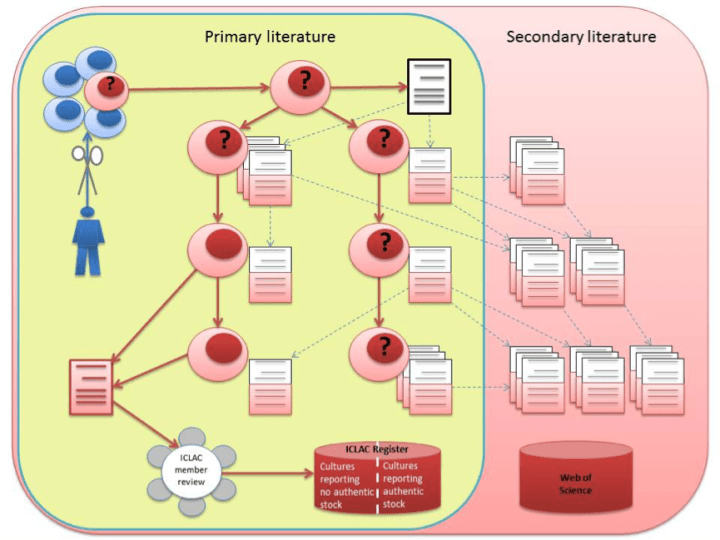
We suggest publications that base results on misidentified cells should get a warning label, allowing the expert reader to assess the consequences for validity.
Horbach, S., & Halffman, W. (2017). The Ghosts of HeLa: How cell line misidentification contaminates the scientific literature. PLOS ONE. doi:10.1371/journal.pone.0186281.
(12 October 2017, open access)
Here is the media attention.
Manifesto out in French
🖋
The Academic Manifesto is now also available in French, in a translation by Michel Lacroix: , Le Manifeste Universitaire: d’une université occupée à une université libre, SPUQ Info – Bulletin de liaison du syndicat des professeurs et professeures de l’université du Québec à Montréal, no. 305, September 2017, p 3-14.
Problematic text recycling in Dutch science
🖋
Text recycling occurs more often than we expected in Dutch science. Up to one in seven papers in Dutch economics contain problematic degrees of text re-use (i.e. more than 10% of the text, with no references to the original, excluding references). Text recycling occurs more often among productive authors, papers with fewer co-authors, and in journals without clear anti-recycling guidelines.
The paper is to appear in an upcoming theme issue for Research Policy, but is available online, open access.
Horbach, S., & Halffman, W. (2017 – in print). The extent and causes of academic text recycling or ‘self-plagiarism’. Research Policy. doi:10.1016/j.respol.2017.09.004.
Here is an overview of the media attention for this paper.
Report to Dutch Parliament
🖋
Now that policy preparation has finished the report I wrote with Ad Ragas on uncertainties in policy for new and emerging hazards was sent to the Dutch Parliament.
The productivist university goes global
🖋
After the world-wide response to the Academic Manifesto, we asked people to explain what was going on in their country.
This is the result of what they sent us:
Halffman, Willem and Hans Radder (eds.) “International Responses to the Academic Manifesto: Reports from 14 Countries.”Social Epistemology Review and Reply Collective Special Report (2017): 1-77.
The report provides an overview of the attempts to implement the productivist university, but also of some successful strategies to resist it, from Quebec to Australia, from Finland to Brazil.
Includes: Willem Halffman and Hans Radder, “The Productivist University Goes Global (and So Does Its Resistance)” and an update on the Netherlands.
The overview was discussed in a Science Guide article.
Paper on biodiversity citizen scientists’ motivation published
🖋
What drives biodiversity citizen scientists? Results of a survey among more than 2000 (!) Dutch field biology enthusiasts show that protecting and learning about nature is a prevailing motivation, much more than fun get togethers. If you were planning to work with citizen scientists, you’d better understand that they are serious about it.
Ganzevoort, W., Van den Born, R., Halffman, W., & Turnhout, S. (2017). Sharing biodiversity data: citizen scientists’ concerns and motivations. Biodiversity and Conservation. doi:10.1007/s10531-017-1391-z (Open Access).
European conference on research integrity
🖋
We are getting together to discuss research integrity in Bonn, February 2018, with ethicists, social scientists, criminologists, philosophers, lawyers, policy makers, scientists, publishers, and a whole bunch other people interested in research integrity.
Hosted by the EU Printeger project, which I coordinate together with Hub Zwart.
 Willem Halffman